
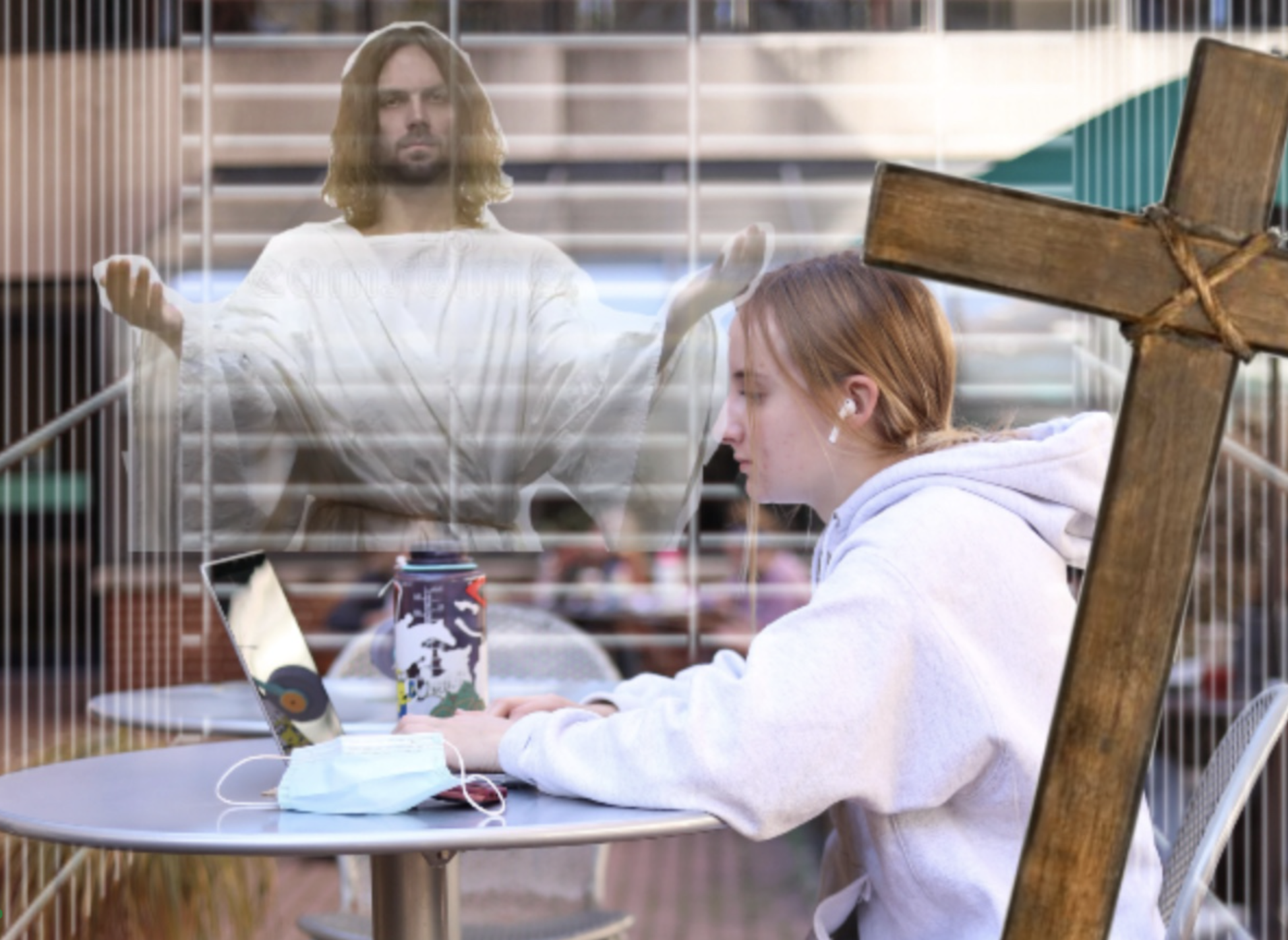
UW Professor Employs Religious Guilt to Combat Cheating
With finals looming over the horizon, the professors of the University of Washington have once again begun their Sisyphian task of reiterating their anti-cheating policies despite knowing full well that the only student paying attention wasn’t going to cheat anyway. Math classes hardly need to worry about cheating, as there’s barely even time to solve the problems— let alone look them up– but with the breadth of subjects offered at the UW, it really is every professor for him/her/theirself.
Among the many methods previously employed at the UW, professors have tried lockdown browsers, unpaid TA surveillance, and Chinese water torture. While these have been initially effective, cheating levels always eventually stabilize to a figure around 5% regardless of the combination of methods. As that figure could be the difference between a patient’s heart exploding or not, there has been a marked dissatisfaction amongst professors with the current status quo. With most conventional methods already tried, the field requires a certain touch of creativity to break past the bottleneck.
Enter professor of economics, Cynthia Walker. With her students behaving so rowdily during exams, she was all but forced to move her exams to Canvas. However, knowing her students were lazy sacks of shit, she came up with a unique strategy to prevent the use of Google or AI: religious guilt.
“The process was simple. I established myself as the one economics priest under God, chosen by him to convey his glories.” As she teaches an intro-level course, she says the students are quite impressionable and willing to believe whatever nonsense she throws at them.
“I began each lesson with subliminal messaging,” she explained, showing our Off Leash reporter a short clip as an example, which was rather unsettling. A figure shrouded in darkness addresses the viewer from a screen blemished by esoteric moving symbols: a snake eating its own tail, a bleeding crow, a clump of writhing mass, and an overflowing goblet of wine. The figure raises its palm, affirms that God is always watching, and dares the viewer to imagine a world of eternal damnation. “I also suggest they picture their loved ones burning eternally, condemned by their sin of dishonesty. All in all, I think it works pretty well,” Walker said.
Professor Walker’s strategy has broken through to students, and her cheating estimation algorithms have consistently returned numbers around 1-2% of offenders. This figure was further confirmed when her Econ 101 class took their latest midterm, and only one student out of two hundred and fifty was condemned to eternal suffering in hell for attempting to deceive God. Additionally, this student’s path of misery and despair did not even stop the exam due to its virtual structure.
Knowing that God watches over all they do, students etch past even fear, and are left too ashamed to cheat. Paranoia seeds itself in their lamb-like chests; they stress over which student might know, what might God think if he found out. In the shadows of every subliminal video, they see His eyes, watching, judging, letting them know they are scum. What is the opportunity cost of cheating on their homework? Not getting into heaven, of course. They are laughing at you, at your weakness. Satan has taken hold of your heart. Every time your mouse hovers over another window, they know.